Total Pageviews

Showing posts with label Veterinarians. Show all posts

Wednesday, June 27, 2012

What do Veterinarians Know About Canine Nutrition?

Dog owners are inundated by messages from advertisements, commercials, the Federal government and agricultural extension services to “consult your veterinarian” about the nutritional needs of our dogs. But what do veterinarians really know about canine nutrition?

I’ll tell you.

Thanks to the insight from a book, “Not Fit for a Dog: The Truth About Manufactured Dog and Cat Food,” by Michael Fox B.Vet.Med., Ph.D., D.Sc., M.R.C.V.S., Elizabeth Hodgkins, D.V.M. and Marion Smart, D.V.M., Ph.D., I recently learned that during four years at vet school at a grueling rate, around 20 hours or less is devoted to nutrition. And even then, the nutrition information veterinarians receive has more to do with the medical  management of diseased and convalescent animals, and nutritional preventative medicine, than it does with feeding healthy dogs for longevity and good health.

So, if we’re only spending 20 hours on nutrition, and the information covered is widely spread and applied to so many types of animals, does vet school really prepare vets to know what  dogs should be eating?

It seems that most vets these days are “recommending” the food that large manufacturers educate them about via sales reps.  The manufacturers are not in the business of making dogs healthy; they’re in the business of making money. I don’t begrudge them this. I am a business owner, and I do it to make money. However, what makes the most money for pet food manufacturers is a product that is shelf-stable for months or years, is cheap to produce (which means using the cheapest ingredients), and is widely adopted by consumers in the marketplace. Raw beef is none of these things.

Here’s how you convince millions of dog owners to starve their dogs with nutritionally inappropriate food, and get them to keep feeding this food to their dogs even when the dogs become sick with allergies, digestive issues, bone and structural weaknesses, cancers and a whole array of skin and eye conditions:

Put the phrase “recommended by  veterinarians” on your packaging. The phrase is meaningless, does not need to be proved, and even if it was recommended by vets, vets are not canine nutritional experts anyway.Use words like “human-grade ingredients” on your packaging. This phrase is equally successful and equally meaningless, since as soon as any ingredient that enters a pet food plant is is considered unfit for human consumption and therefore cannot be called “human-grade.”Educate veterinarians. Send out an army of sales reps with slick brochures and lucrative sell-through contracts for your food.Tell consumers to “consult with your veterinarian” about what to feed their dogs. Because the veterinarians are selling your food. Do this through government agencies, public awareness campaigns, and “educational” materials pushed out to Federal, state and local agencies.Take advantage of consumer messages about what’s “healthy.” Convince humans to apply human dietary recommendations to their dogs. These include the concepts of vegetarian diets being better than meat-based diets, “balanced” ingredients rather than a majority of the diet being meat protein, and the appeal of nutriceuticals (using food as a drug to treat various ailments up to and including old age).When dogs come down with a variety of nutritional and immunological conditions, tell vets to recommend different commercial dog foods and supplements, rather than feeding a natural diet.Scare consumers about raw diets, raw meat, raw bones, and other foods critically essential to the canine diet. In the age of dental rinse, hand sanitizer and pop-up Lysol wipes, it’s easy to do; more than 700 products enjoy commercial success due to advertising their antimicrobial properties.Rename things. Dangerous coloring and flavoring agents sprayed onto grain-based kibble to make them look like “meat” can be called animal “byproducts” or “enhancers.”

As a culture, we have lost confidence in ourselves to make decisions for our healthcare, education, and a host of other areas, including our dogs’ nutrition. We are told at every turn to just do what the experts tell us to do. We relinquish our responsibilities to doctors, professors, veterinarians and others in positions of knowledge authority. However, these “experts” may not know what is best for us. We need to take back authority for making these decisions.

If we like a certain food because it has beef, rice, and broccoli, why not just feed our dogs beef, rice and broccoli? Why are we not questioning why commercial dog food NEEDS so much flavor enhancer, stabilizers, added nutrients, preservatives, antimicrobials, antifungals, emulsifiers, coloring agents … the list goes on. We look for the bag of food (that’s been sitting on the shelf for six months), hoping the first ingredient is beef or chicken. Not once does it occur to us how beef or chicken can sit on the shelf for six months.

So, repeat after me:

I am responsible for my dog’s health and his diet, not my veterinarian. I will find out what my dog needs, what types of foods deliver those nutrients, and how to serve it to him in a way that he gets the nutrition he needs. I will not rely on dog food companies to decide what I should feed my dog by using my vet to pressure me into buying their product.

accountantsco

View the original article here

Thursday, September 1, 2011

How to make a veterinarian’s day

Share on Facebook Tweet this Google Buzz Digg It Share on technorati Stumble upon it Add to delicious Email

I feel sorry for veterinarians. It must be so difficult to be trained to save animals’ lives and then be told on a regular basis that owners can’t afford the treatment. Economic euthanasia, it’s called. Jerry still vividly recalls being at the specialty hospital with our Greyhound and watching a father have to tell his young son that they couldn’t afford to treat their dog. I would never judge anyone who’s made that decision, and I am grateful every day that I’ve never had to make it. But today, I hope that I was able to make a veterinarian’s day. I think maybe I did, a little bit anyway.

I had to take Twyla to the hospital this morning. When Jerry got up to feed the girls, he noticed that Twyla’s breathing sounded wet, and occasionally she was having a little trouble drawing breath. He didn’t think she should wait to be seen at our regular vet, so I drove her to the ER. Luckily, the timing and the traffic gods were with us, and we didn’t get stopped in rush-hour traffic and no traffic cops saw me zoom through a green light going 60 instead of 50. They took us right in–I had called ahead–and within a few minutes the veterinarian was telling me that Twyla was in congestive heart failure.

“You should know that once they reach this stage, the prognosis isn’t very good,” she said. “Do you want to proceed with treatment?”

I probably had a stunned expression on my face. “Of course.”

Later, she was giving me the estimate for two to three days of hospitalization, in something of a resigned tone of voice. I’m sure the voice in her head was thinking, “Well, now she’ll change her mind.”

She barely got the numbers out before I said “Fine.”

Then she smiled big.

Now I’m smiling, for a while, anyway, because Twyla is doing better. We might be able to take her home tomorrow.


View the original article here

Sunday, April 24, 2011

When veterinarians make mistakes

Share on Facebook Tweet this Google Buzz Digg It Share on technorati Stumble upon it Add to delicious Email

ICU was busy last week. We had the usual assortment of trauma, infections and various other conditions to manage.  It was not lethally busy, where I fear the caseload will overwhelm the caregivers and lead to substandard care (or worse), but busy enough that you had to keep moving, dodge bullets, dance with death, and think on the fly.

I had a patient who required a bronchodilator, a  medication that’s a distant relative of caffeine, and aids breathing by opening up lung passages and strengthening the muscles of respiration.

The medication, terbutaline, is a pretty commonly used one and has a reasonable safety profile; it’s hard to harm a patient with it, even with an overdose. The effects of an overdose are nervousness, rapid heart rate and possibly an irregular heart rhythm, like having a couple of grande cappuccinos floating around your system. Not pleasant, to be sure, but probably not going to hasten your demise, either.

At the time I wrote the order, I was preoccupied with getting this patient in for a CT scan and trying to organize all the various services that go into this — radiology to perform the scan, neurology to interpret the scan and anesthesia to keep her alive and anesthetized during the scan.  I had many plates spinning, plus a few other ICU patients I was making decisions on at the same time.

I had not used terbutaline in a while, so I looked up the dose in our ICU formulary (a book that lists information about drugs, along with the doses) and did the calculations in my head.

The formulary lists the dose as 0.01 milligrams per kilogram (or mg/kg) and the patient weighed 4 kg.  The total dose should have been 0.04 mg, but somehow I dropped a 0 and ended up with 0.4mg – a 10-times overdose.  I wrote this erroneous dose on the treatment sheet and asked the student to go to the pharmacy and retrieve the drug.

I then went back about the logistical routine of what I call the “poultry alignment process,” or getting my ducks in a row. I had a narrow window to get this patient in for a CT scan, and I didn’t want to miss the opportunity. I felt like a bike messenger delivering an important parcel, and dodging taxis, cars and buses along the way; I had to the thread the needle just right to get the CT coordinated.

In my haste and distraction, I didn’t notice the wrong dose.  Luckily for my patient, and for me, the student did.  She came back from the pharmacy and said, “Shouldn’t the dose be 0.04 ml, instead of 0.4ml?” I went back to the formulary and confirmed that I had made an error, and thanked her for being on the ball.

Her CT went off as planned, and she recovered well from her malady.

In this particular case, the error was caught, the overdose avoided and the proper dose given. Even if the overdose had been given (I told myself), the patient would likely not have been worse off, just a tad nervous.

But, I realize that it could have been far worse — if it had been another drug, like potassium chloride (a commonly used fluid supplement) or propofol (an anesthetic) I could have mistakenly written an order for a lethal dose.

My error could have killed someone’s pet.

For humans, medical errors injure more than 1.5 million people a year and result in 7000 deaths. No one knows the number of times it happens for for pets, or how many lose their lives as a result, but the numbers are certainly comparable. The government keeps numbers for human medical errors, but their attention for animals is usually limited to making sure they are relatively safe to eat.

We have a review process for serious medical errors here, and I am a firm believer in full disclosure for pet owners when it does happen. I am also a believer in apologizing for errors, but lawyers often advise against it because they see it as an admission of guilt.  Recent thinking on the topic, though, has shown that people who were harmed by a medical error are actually less likely to sue if they receive a sincere apology. To me, it just seems like the right thing to do.

Luckily, I have only had to do this once, and it was not a direct error on my part. I was the attending on the case, though, so I was responsible. The owners took it well in that case and were understanding (their pet was not harmed by the mistake).

Not every error results in harm to the patient. There is a huge dose range for most drugs (sometimes as much as a 10-fold variation in how much drug we can give) and animals and humans have a tremendous capacity for staying healthy despite our efforts to the contrary.

All these facts about a patient resistance to harm and dose ranges smacks of whistling in the dark to me, however. These are the things I tell myself so I feel like I am doing more good than harm, on balance.

This time, we both got lucky. I know I will be on high alert for a while, but eventually I risk falling back into old rhythms. I can only hope that I have another astute student to help me avoid harming my patient the next time it happens.

Photo: My patient in the CT scanner


View the original article here

Wednesday, March 9, 2011

Veterinarians can combat the decline in visits

Share on Facebook Tweet this Google Buzz Digg It Share on technorati Stumble upon it Add to delicious Email

VIN News Service‘s Edie Lau gives us an inside view into one of the current dilemmas faced by veterinary practices today — the big decline in visits to clinics and animal hospitals.

A study presented at the recent North American Veterinary Conference in Orlando looked at the factors impacting the challenges veterinary practices are facing:

One notable factor is that the number of companion-animal practitioners has exploded in the past decade, rising from 30,255 to 44,785 between 1996-97 and 2006-07, a rate of 48 percent — greater than the rate at which the pet population grew during the same period.

The upshot is that the median number of active clients per full-time-equivalent veterinarian is in steady decline, dropping from 1,200 in 2001 to 1,070 in 2009, according to Financial & Productivity Pulse Points, published by the American Animal Hospital Association Press.

The study goes on to suggest that the rising number of practicing veterinarians isn’t creating the problem, but rather, increasing it. Another cause? Believe it or not, the internet.

John Volk, a senior consultant for Brakke Consulting, the firm which produced the study with Bayer Animal Health, pointed to several causes (which Lau  recounts in her article), but he maintains that there are times when spending a day or three doing research on a veterinary issue can become problematic.

Thirty-nine percent of pet owners surveyed indicated that they always or usually look online first when they notice that their pets are sick or injured.

Fifteen percent completely or somewhat agreed with the statement, “With the Internet, I don’t rely on the vet as much.”

Volk acknowledged that some pets recover on their own but said that in those that don’t, the delay in treatment is evident to practitioners. “I’m seeing pets three days sicker these days,” one veterinarian told researchers.

It’s a thought-provoking study, and I hope people study its conclusions carefully. Veterinarians are too important to lose or take for granted.

The Honest Kitchen’s new vendor pledge: On the heels of one recall after another for various types of contamination, it’s refreshing to see a pet food company taking a firm stand for saftety.  The Honest Kitchen (full disclosure: a Pet Connection sponsor) is instituting a formal vendor pledge. Meaning, if you’re going to do business with THK by supplying them with ingredients, you must certify your adherence to a series of guidelines, including:

Not genetically modified or subject to engineered recombinant DNA technologyVerification that it is free of chemicals or adulterantsPost-harvest handling: verification that it is free of chemical preservatives such as EthoxyquinSustainability and fair-trade attributes where applicableVerification of screening for contaminants such as salmonella, e-Coli, Coliform, lead, arsenic, mercury and melamine, in accordance with human food safety standardsA promise that the ingredient does not originate from China

That wasn’t so hard now, was it? Certain companies out there would do well to follow THK’s lead. We don’t need to name them here.

Pet flight travel report: Did you know there’s a site where you can view an accounting of recent incidents in pet flight travel? Check out petflight.com‘s page on December 2010 reports. Since Gina’s Faith (a.k.a. FayBee, Charter Member of the Bad Girls’ Club) is going to be boarding a plane later this week for a little vacation, I thought this would be a good time to get the word out. Have fun, FayBee! Try to be nice to the inflight crew, OK?

Texas police dog undergoing treatment: A police dog from Waco, Texas is being treated at the famed University of California-Davis Veterinary Hospital for a life-threatening case of leptospirosis. News 10 of central Texas has the story. Last fall I was fortunate enough to get a guided tour of the hospital where Torro is being treated. It’s an incredible facility.  Torro is in excellent hands.

Life’s ruff: A man named Chris Dignan has created a program called “Life’s Ruff,” which is a show about shelter dogs trained to do some great stuff. There’s a video here, which you might end up watching a few times.

Puppy Bowl VII approaches: Next Sunday afternoon, there will be a nationally televised event that people have been waiting for all year. Parties are held to celebrate the athletic achievement. Commercials for the event cost more. No, I’m not talking about the Packers playing the Steelers in Arlington, Tex. I’m referring to Puppy Bowl VII, being shown on Animal Planet. This past week, the starting lineups were unveiled. Facebook users can take part in official betting pools on who the MVP (Most Valuable Puppy) will be. I have a favorite, but I’m not sayin’ who it is.

Important flow chart: People like me (dog owners who don’t have cats…what did you think I meant?) need simple visual aids to understand how the other half lives. I stumbled upon this handy dandy chart, and I feel I’m better informed now.

Hamster agility! I’ve seen dog agility. I’ve seen cat tricks. I’ve seen remarkable horses. Agile rabbits. I’ve never seen this.
.

.

Doxy in snow: I’m asked a lot whether Cami and Harry like heavy snowfalls, and how they cope. This might be as good an answer as any (thanks, Ericka).
.

.

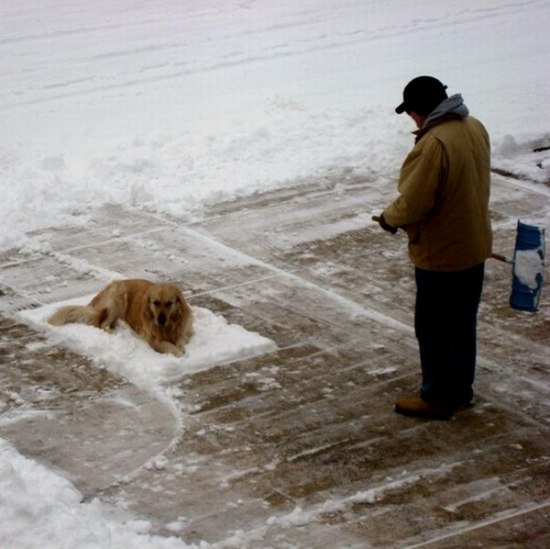
Not one but TWO pictures of the day:
A very, VERY good Golden retriever (thanks again, Patti), and a street sweeper in Moscow who would prefer not to disturb some citizens (thanks to Marge for that one).

I always like to hear from readers, especially if you have tips, and links for interesting stories.  Give me a shout in the comments, or better yet, send me an e-mail
Photo credit: Cat with veterinarian, Flickr Creative Commons (Jeffrey Beall)


View the original article here